

4D Printing Market Growth Forecast Supported by Rising Demand and Innovation
4D Printing Market
4D Printing Market Size, Share and Research Report By Technology (Shape Memory Polymers, Self-Assembly, Bioprinting), By Material Type (Polymers, Metals)
4D Printing Market is advancing with smart materials and programmable structures enabling dynamic, shape-changing products across industries.”
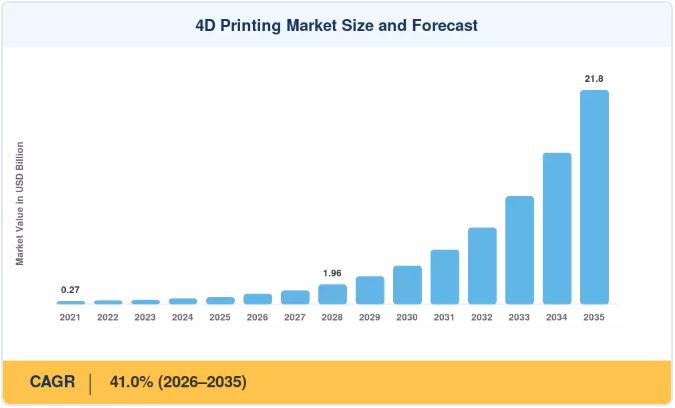
TAIPEI, TAIPEI, TAIWAN, August 25, 2026 /EINPresswire.com/ -- The Global 4D printing market reached an estimated USD 0.70 billion in 2025 and is projected to grow from USD 0.99 billion in 2026 to USD 21.80 billion by 2035, registering a CAGR of 41.0% during the forecast period. Two major catalysts are accelerating this trajectory: rapid advancements in smart material science particularly shape-memory polymers, hydrogels, and multi-responsive composites and surging investment in biomedical and aerospace applications where self-transforming structures offer unprecedented design freedom. With over USD 2.8 billion in R&D funding directed toward programmable matter technologies globally, manufacturers, research institutions, and defense agencies face mounting pressure to integrate 4D fabrication capabilities or cede ground to early-adopting competitors.— Market Research Future (MRFR)
Conventional additive manufacturing even advanced multi-material 3D printing platforms produces static structures that cannot adapt to environmental stimuli after fabrication. Fourth-dimensional printing resolves this limitation by embedding programmable transformation logic directly into printed geometries, enabling structures that autonomously respond to heat, moisture, light, magnetic fields, or mechanical stress. A recent Gartner Emerging Technologies report estimated that leading biomedical device manufacturers deploying 4D-printed scaffolds and drug delivery systems reduced surgical intervention complexity by 31–38% compared to conventional implant strategies. This capability shift is not incremental it represents a foundational re-engineering of how intelligent, adaptive structures are designed, fabricated, and deployed.
Get Full PDF Sample Copy of Report: (Including Full TOC, List of Tables & Figures, Chart) @ https://www.marketresearchfuture.com/sample_request/2692
➤ How Significant Is the 4D Printing Market’s Growth?
The 4D printing market has demonstrated extraordinary expansion momentum, rising from approximately USD 0.29 billion in 2021 to an estimated USD 0.70 billion in 2025, reflecting a remarkable historical growth trajectory fueled by intensifying cross-industry interest in programmable, stimuli-responsive fabrication. The market is projected to expand more than eleven-fold over the next decade, driven by accelerating commercialization of smart material platforms, growing clinical adoption of bioprinted adaptive implants, and expanding aerospace and defense programs exploring deployable 4D-printed structures for space and autonomous vehicle applications.
Breakthrough demonstrations including MIT’s self-assembling water infrastructure prototypes, Harvard’s 4D-printed soft robotics actuators, and NASA-funded deployable antenna structures have validated the technology’s commercial readiness beyond laboratory environments. Healthcare systems, automotive OEMs, defense procurement agencies, and consumer goods companies are all actively piloting 4D printing workflows to unlock adaptive design capabilities that static manufacturing processes fundamentally cannot deliver.
➤ What Does the Future Hold for the 4D Printing Market?
Smart materials innovation and multi-stimulus programming stand at the forefront of the market’s next growth phase. Next-generation 4D printing platforms are moving beyond single-stimulus shape-memory polymers toward multi-responsive material systems that can execute complex, sequenced transformation behaviors in response to combined thermal, hydric, optical, or electromagnetic inputs. These capabilities are enabling entirely new product categories from self-deploying surgical tools to morphing aircraft wing surfaces that are impossible to achieve with any alternative manufacturing paradigm.
The growing convergence of 4D printing with artificial intelligence and generative design is another defining force shaping the market’s future. AI-driven topology optimization tools can now compute optimal material distribution patterns that maximize transformation accuracy, structural integrity, and energy efficiency within printed geometries reducing design iteration cycles from months to days. When paired with high-resolution multi-material printing platforms, these generative workflows are enabling an unprecedented pace of innovation across the biomedical, aerospace, and soft robotics sectors.
Bioprinting and regenerative medicine represent perhaps the most transformative near-term application frontier. 4D-printed tissue scaffolds, vascular grafts, and drug-eluting implants that autonomously reshape in response to physiological conditions are advancing through clinical trial pipelines globally. As regulatory frameworks mature and material biocompatibility validation accelerates, the biomedical segment is expected to become the single largest end-use vertical for 4D printing technologies by the early 2030s.
Buy this Premium Research Report at: https://www.marketresearchfuture.com/checkout?currency=one_user-USD&report_id=2692
➤ Who Are the Key Players in the 4D Printing Market?
The 4D printing landscape is characterized by a dynamic mix of advanced manufacturing equipment vendors, smart material developers, specialized bioprinting companies, and government-backed research consortia. Key participants shaping the competitive dynamics include:
Stratasys Ltd. — pioneering multi-material PolyJet printing platforms that form the hardware backbone for many 4D printing research and commercial workflows
3D Systems Corporation — providing high-resolution SLA and multi-material printing systems alongside material development programs targeting smart polymer applications
Materialise NV — delivering software and printing services that support complex 4D geometry programming for medical and industrial clients
EnvisionTEC (Desktop Metal) — offering precision DLP-based bioprinting and industrial 4D fabrication platforms for medical device and industrial end-users
Organovo Holdings — pioneering bioprinted human tissue models with active research programs in 4D-responsive therapeutic structures
Autodesk Inc. — providing generative design and simulation software critical for engineering the transformation behaviors of 4D-printed geometries
Airbus SE — actively investing in 4D-printed morphing structural components for next-generation commercial and defense aerospace applications
Covestro AG — developing high-performance shape-memory polyurethane and thermoplastic elastomer feedstocks purpose-engineered for 4D fabrication
Evonik Industries — supplying specialty polymer materials including PEEK, PEBA, and shape-memory formulations for demanding 4D printing applications
Nanoscribe GmbH — enabling microscale 4D printing through two-photon polymerization platforms for microrobotics, optics, and biomedical microdevice fabrication
Competition in the market is intensifying as participants race to develop proprietary smart material libraries, establish IP positions around transformation programming methodologies, and secure strategic research partnerships with leading academic institutions and government defense laboratories. Mergers and acquisitions activity is also accelerating as established additive manufacturing vendors seek to acquire specialist 4D printing capabilities.
➤ What Are the Emerging Trends in the 4D Printing Market?
Several transformational trends are redefining how the 4D printing market evolves through 2035:
Multi-Stimulus Responsive Materials: Shape-memory polymers, hydrogels, and magnetically active composites capable of executing complex, sequenced transformation behaviors are advancing beyond laboratory settings into pilot commercial production, dramatically expanding the design space for adaptive structures.
Bioprinting & Regenerative Medicine: 4D-printed tissue scaffolds, vascular grafts, and orthopedic implants that autonomously reshape to match patient anatomy or respond to healing-phase biochemical signals are advancing through clinical validation pipelines, positioning biomedical as the market’s fastest-growing end-use vertical.
Aerospace Morphing Structures: Defense agencies and commercial aerospace OEMs are actively funding programs to develop 4D-printed wing morphing surfaces, deployable satellite components, and adaptive thermal protection systems that deliver mission-adaptive performance impossible with conventional structural materials.
Soft Robotics & Actuator Integration: 4D-printed pneumatic actuators, grippers, and locomotive structures are enabling a new generation of compliant robots capable of safe human interaction, confined-space navigation, and delicate manipulation tasks with broad applications in logistics, surgery, and hazardous environment inspection.
AI-Driven Transformation Programming: Generative design algorithms and physics-informed neural networks are being integrated into 4D printing design workflows, enabling automated computation of material distributions, print orientations, and geometry parameters that achieve target transformation behaviors with minimal trial-and-error iteration.
Sustainable & Bio-Derived Smart Materials: Growing sustainability mandates are driving development of bio-based shape-memory materials derived from cellulose, chitosan, and plant-based polyesters enabling 4D-printed products that are both functionally adaptive and environmentally biodegradable at end-of-life.
Get access to the full description of the report @ https://www.marketresearchfuture.com/reports/4d-printing-market-2692
➤ How Is the 4D Printing Market Segmented?
The 4D printing market report provides a comprehensive segmentation framework:
1 By Material Type: Shape-Memory Polymers, Hydrogels, Shape-Memory Alloys, Programmable Carbon Fiber, Cellulose-Based Composites
2 By Printing Technology: Fused Deposition Modeling (FDM), Stereolithography (SLA), Selective Laser Sintering (SLS), PolyJet, Direct Ink Writing (DIW)
3 By End-Use Vertical: Healthcare & Biomedical, Aerospace & Defense, Automotive, Consumer Products, Construction & Infrastructure, Soft Robotics
4 By Stimulus Type: Thermal, Hydric (Water/Moisture), Magnetic, Light/Photo-Responsive, Multi-Stimulus
5 By Organization Type: Research Institutions & Universities, SMEs, Large Enterprises, Government & Defense Agencies
➤ What Are the Regional Insights from the 4D Printing Market?
North America commands approximately 38% of global 4D printing market share, underpinned by the concentration of world-leading research universities (MIT, Harvard, Stanford, Caltech) pioneering programmable matter science, extensive DARPA and DoD funding for adaptive defense materials, and a mature venture capital ecosystem supporting advanced manufacturing startups. The region’s strong biomedical device industry and early FDA engagement on 4D-printed implant regulatory pathways further reinforce its dominant position.
Europe holds the second-largest share at approximately 29%, with Germany, the United Kingdom, Switzerland, and the Netherlands representing the primary markets. Horizon Europe funding programs, strong automotive OEM innovation pipelines (BMW, Airbus, Volkswagen), and world-class polymer chemistry research institutions are driving substantial 4D printing investment. The EU’s strategic focus on advanced manufacturing sovereignty is accelerating both public and private sector 4D printing adoption.
Asia-Pacific is the fastest-growing major region, with China, Japan, South Korea, and Singapore making significant national investments in 4D printing research and commercialization. China’s Made in China 2025 and subsequent advanced manufacturing initiatives have directed substantial funding toward smart material fabrication capabilities. Japan’s precision manufacturing ecosystem and South Korea’s materials science research base are generating notable 4D printing patent filings and commercial pilot programs.
Middle East & Africa is projected to register the highest CAGR at approximately 26.8% through 2035. UAE and Saudi Arabia’s ambitious technology diversification agendas including NEOM and multiple smart infrastructure megaprojects are creating substantial demand for advanced adaptive construction and infrastructure materials. Government-funded research institutes in the UAE are actively establishing 4D printing centers of excellence to support regional capability development.
South America rounds out the global picture, with Brazil and Chile representing the most active markets for 4D printing research and early commercial adoption, primarily within academic, biomedical, and oil & gas applications.
➤➤➤ Industry Analysis Reports by Market Research Future:
Digital Payment Market-
https://www.marketresearchfuture.com/reports/digital-payment-market-7572
Chemical Sensors Market-
https://www.marketresearchfuture.com/reports/chemical-sensors-market-7582
Smart Pneumatics Market-
https://www.marketresearchfuture.com/reports/smart-pneumatics-market-7589
Broadcasting Equipment Market-
https://www.marketresearchfuture.com/reports/broadcasting-equipment-market-7645
All-Flash Array Market-
https://www.marketresearchfuture.com/reports/all-flash-array-market-7654
Current Sensor Market-
https://www.marketresearchfuture.com/reports/current-sensor-market-7658
Emission Monitoring System Market-
https://www.marketresearchfuture.com/reports/emission-monitoring-system-market-7710
Security Cameras Market-
https://www.marketresearchfuture.com/reports/security-cameras-market-7744
Fpga Security Market-
https://www.marketresearchfuture.com/reports/fpga-security-market-7762
Digital Payment In Healthcare Market-
https://www.marketresearchfuture.com/reports/digital-payment-healthcare-market-7977
Market Research Future
Market Research Future
+16282580071 ext.
email us here
Legal Disclaimer:
EIN Presswire provides this news content "as is" without warranty of any kind. We do not accept any responsibility or liability for the accuracy, content, images, videos, licenses, completeness, legality, or reliability of the information contained in this article. If you have any complaints or copyright issues related to this article, kindly contact the author above.
